Our Story
The Journey Behind US Patent 12,001,207
How it started
When this research began in the mid-2010s, autonomous vehicles were still mostly a concept. The patent (US 12,001,207, priority date August 2019, issued June 2024) protects a camera-based safety system that came out of that work. Since then, the industry has moved fast — robotaxis and autonomous delivery vehicles are now in deployment, and Tesla's FSD v12+ showed what camera-first systems can do.
Technical approach
At the time, most of the industry was focused on lidar-driven, sensor-heavy systems with detailed mapping and object classification. This research took a different direction, asking a simpler question:
How can an autonomous vehicle navigate, maintain its path, and avoid obstacles using vision as the primary input?
The resulting patent (US 12,001,207) protects a dual-module safety system that compares live camera images with pre-recorded route images to determine whether navigation is safe. It's not purely map-free navigation, but it reduces dependence on frequently-updated mapping infrastructure. The continuation (US 12,530,030) extends this with end-to-end deep learning coverage: the system learns to drive by watching human operators, converting camera images and navigation instructions into control values through a trained network (Claim 13).
Industry validation
The industry has since moved toward camera-based approaches. Tesla's FSD v12+ uses camera-fed neural networks, and confidence in vision-first architectures has grown. Meanwhile, companies that bet heavily on lidar and sensor-fusion have run into trouble — Cruise suspended operations in late 2023 after substantial investment. Multiple factors contributed to Cruise's situation, but the contrast is worth noting.
Market opportunity
Autonomy is mostly a software problem, which means potentially higher margins than hardware. A licensing model can target software providers through per-vehicle or subscription-based agreements.
Scale and growth
Tesla's FSD program already covers hundreds of thousands of vehicles, and the broader autonomous vehicle market continues to expand. Beyond passenger cars, camera-based navigation applies to delivery vehicles, commercial drones, and industrial robotics.
Camera-based approaches have proven viable in several contexts, though adoption still depends on specific use cases and regulatory approval.
What the patent covers
Camera-based safety architecture
The patented system (US 12,001,207) covers:
- A dual-module architecture separating safety determination from vehicle control
- Live camera image comparison with pre-recorded route imagery
- Safety value calculation to determine when navigation instructions can be safely executed
- Visual navigation point recognition for high-level route following
- Safety-threshold mechanisms including human operator intervention requests
Prototype capabilities demonstrated in research (some covered by the patent):
- Real-time autonomous navigation using camera inputs as primary sensor
- Decision-making based on visual scene correspondence and uncertainty assessment
- Remote teleoperation and data collection for route training
- Imitation learning from recorded human driving demonstrations
Note: The research process explored various vision-based learning approaches. The patents protect specific implementations including deep learning-based implementations (Claim 13 of the continuation explicitly covers deep learning via network topology), rather than all conceivable end-to-end training methods.
Demo
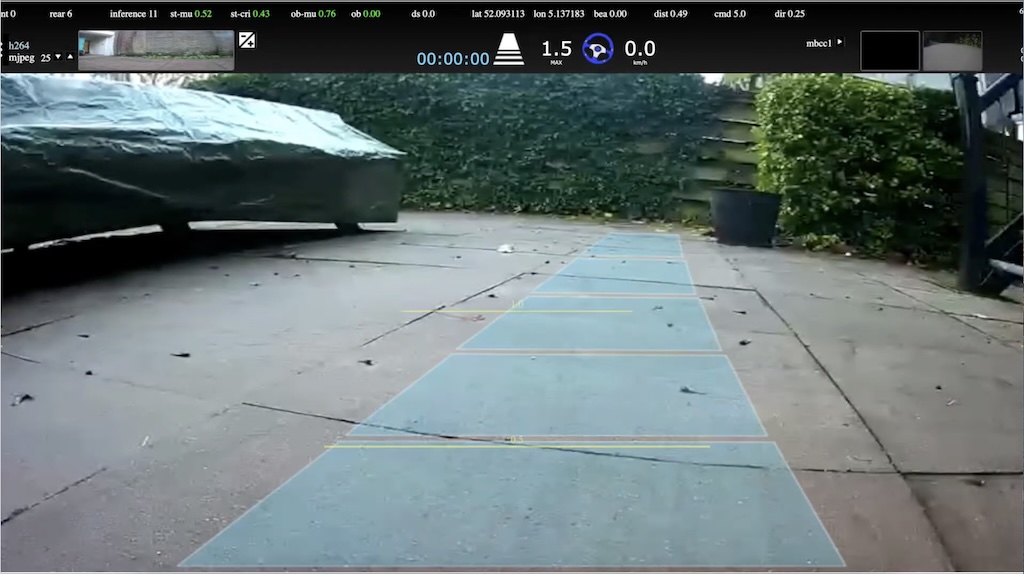
An autonomous research vehicle navigating with vision-based controls, showing path visualization and obstacle awareness.
Why it's available for licensing
Regulation
The startup was self-funded. It had customer commitments and local regulatory approvals in a rural area of the Netherlands, but getting final approval from the central government proved too difficult for a small organization.
Scale
Deep learning requires more data and compute than most people expect. The technology works, but commercializing it requires investment beyond what a small team can provide.
In short: regulatory processes favor larger organizations, AI needs massive data collection, neural network training needs serious infrastructure, and generalization across environments requires extensive real-world testing. Independent development wasn't feasible.
What this means for licensees
What was too big for a small team is an opportunity for organizations with the resources, scale, and regulatory experience to use the patented technology.
How companies use it
- Add vision-based navigation IP to an existing patent portfolio
- Address potential infringement in camera-first systems
- Build defensive IP coverage as the industry shifts to vision-based methods
- Skip development time by licensing existing IP
Where things stand
The patent protects a camera-based safety determination system for autonomous navigation and is available for licensing.
The industry has moved from skepticism about camera-only systems toward accepting vision-first approaches, though the sensor fusion vs. vision-only debate continues. Several deployments have shown autonomy is possible without heavy reliance on lidar, though many systems still use multiple sensors for redundancy. Technical approaches range from pre-recorded route matching (as in this patent) to generalized neural networks. The industry's shift toward end-to-end learned driving, where neural networks convert camera images into vehicle control commands, aligns with what Claim 13 of the continuation patent covers.
Technology validation
| Validated Capability | Description |
|---|---|
| Autonomous Navigation | Real-world test environments (not simulation only) |
| Obstacle Detection & Avoidance | Vision as primary sensor (camera-based) |
| Route Following | Pre-recorded visual reference data (patent-described method) rather than continuously-updated detailed infrastructure maps |
| Multi-Platform Architecture | Applicable to both ground vehicles and aerial systems |
These capabilities were validated through internal development and real-world testing according to developer testing; results may vary in broader applications and independent verification may be needed for commercial deployment.
Industry direction
The AV industry is in flux. Systems like Tesla's FSD v12+ show camera-based architectures can work, though hybrid approaches remain common.
Trends worth watching:
- Movement from lidar-heavy to camera-first architectures in some implementations
- Growing emphasis on software differentiation
- Expansion into delivery and robotics
- New regulatory frameworks for autonomous operations
Licensing opportunities span automakers, AV software providers, camera-based system developers, and drone/robotics companies.
Licensing
The patent covers a tested, validated technical approach to vision-based navigation — built during a period when the industry was heading in this direction.
A license includes the patent coverage itself, along with the technical knowledge and system architecture behind it. We offer exclusive and non-exclusive arrangements, per-vehicle models, and partnership structures.
Who it's for
The patent applies to automakers with autonomous capabilities, AV software companies, delivery fleet operators, drone manufacturers, and robotics firms with mobile platforms — anyone building vision-based navigation systems.
Get in touch
We're open to discussions about licensing terms and how the patent applies to your work.
For inquiries on licensing US Patent 12,001,207, contact information is provided on the contact page.
Ready to License This Patent Portfolio?
Start a confidential licensing inquiry for your autonomous vehicle or drone navigation projects.
Start Licensing Inquiry